18 June 2015

Gili Aer to Komodo National Park - 300 miles east

It finally feels like we are cruising.  We are relaxing in sunbaked anchorages, surrounded by spectacular mountainous volcanic islands, and turquois blue, clear water that is teeming with coral and very colorful fish.  We are now in Komodo National Park and our plan is to stay in the park and its numerous islands until we head back to Australia mid to late July. 
We departed on our local 300 mile or so journey to Komodo National Park from Gili Aer, Lombok on June 11.  We anchored in five overnight anchorages, sailing during the day.  We stopped at Gili Lawang, Moyo Island, Kananga, Kilo and Wera Bay before making the hop across to Komodo Island on June 18.

Gili Lawang
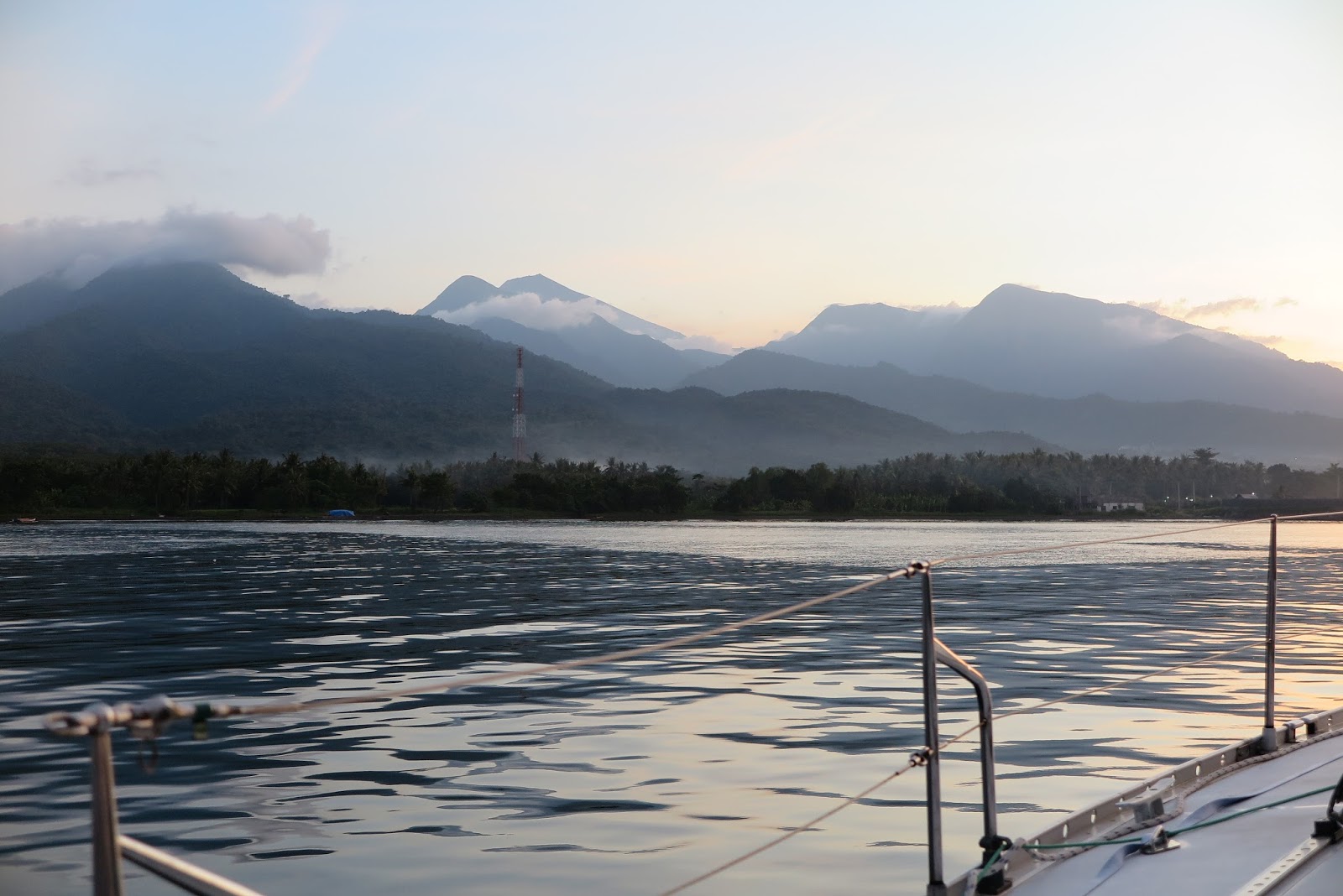
A calm evening at anchor over the black sands of Gili Lawang
The anchorage at Gili Lawang is a sheltered area between the main island of Lombok and the smaller island of Gili Lawang.  Set offshore of a small village, it must be a squid fishing paradise judging by the large numbers of very big squid boats that fished around us all night with their very bright spot lights shining on the water to attract their prey. 


It was our first ‘black sand’ anchorage.  The dark nature of the volcanic sands make it very difficult to judge water depth visually, which is nerve wracking when coming in to shore from the sea. 


The sunset at Gili Lawang was like a watercolor painting
We found a nice spot, and were the only sailboat anchored off the village that night.  In fact we saw no other sailboats all day, something that we would get used to, but for now seemed strange.  The scenery from the anchorage in the evening as the sun set was just stunning, beautiful lush green complex hillsides that sloped upwards in to the clouds that shrouded the volcanic peaks. 
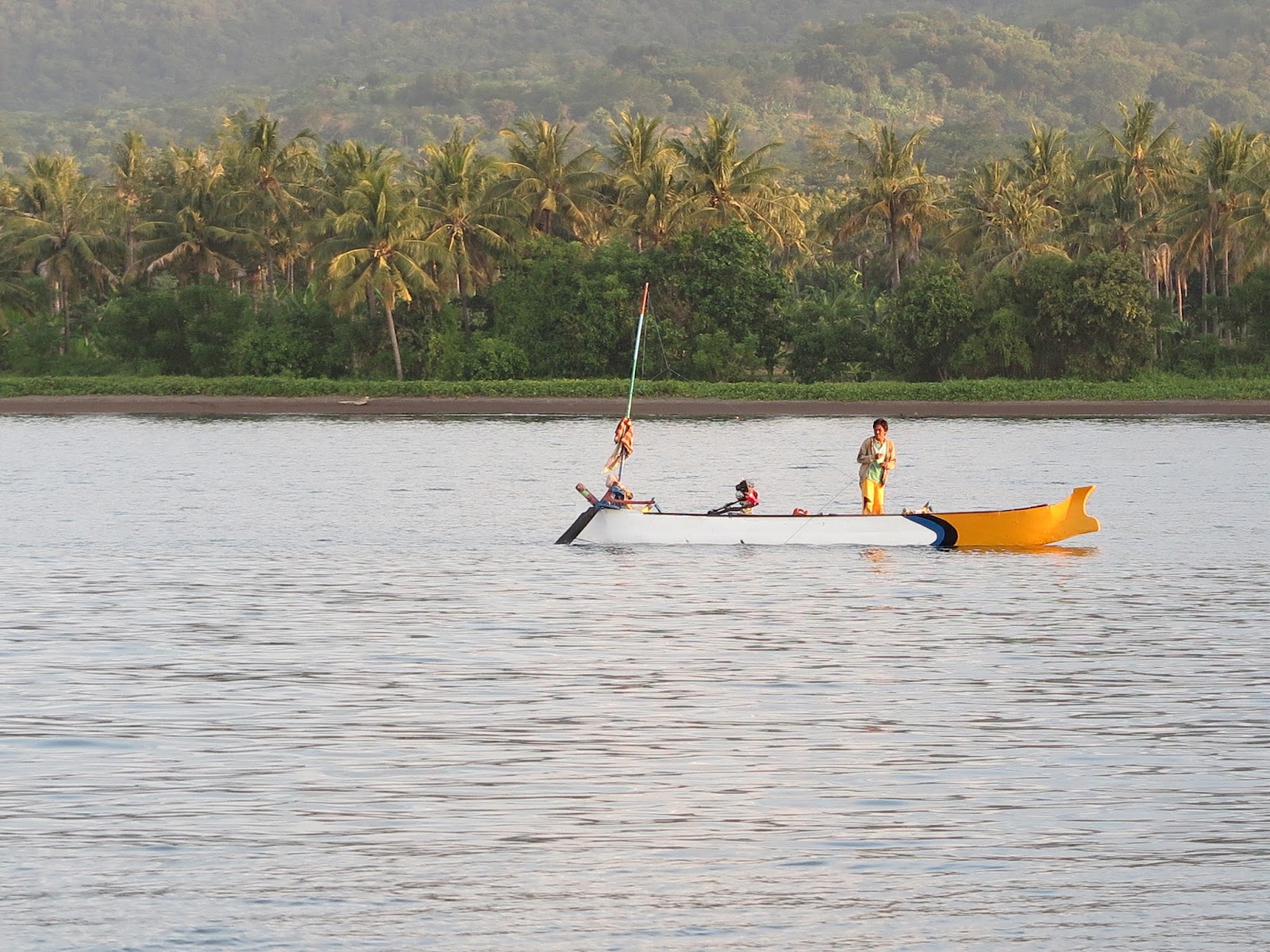


A beautiful fishing canoe, Gili Lawang

There was the most incredible local fishing boat, an outrigger canoe, that came near in the evening light.  The yellow, white, blue and black canoe was different than any we saw to date, with an outrigger on only one side.  It clearly is well loved, judging by how it gleamed in the evening light.


Moyo Island
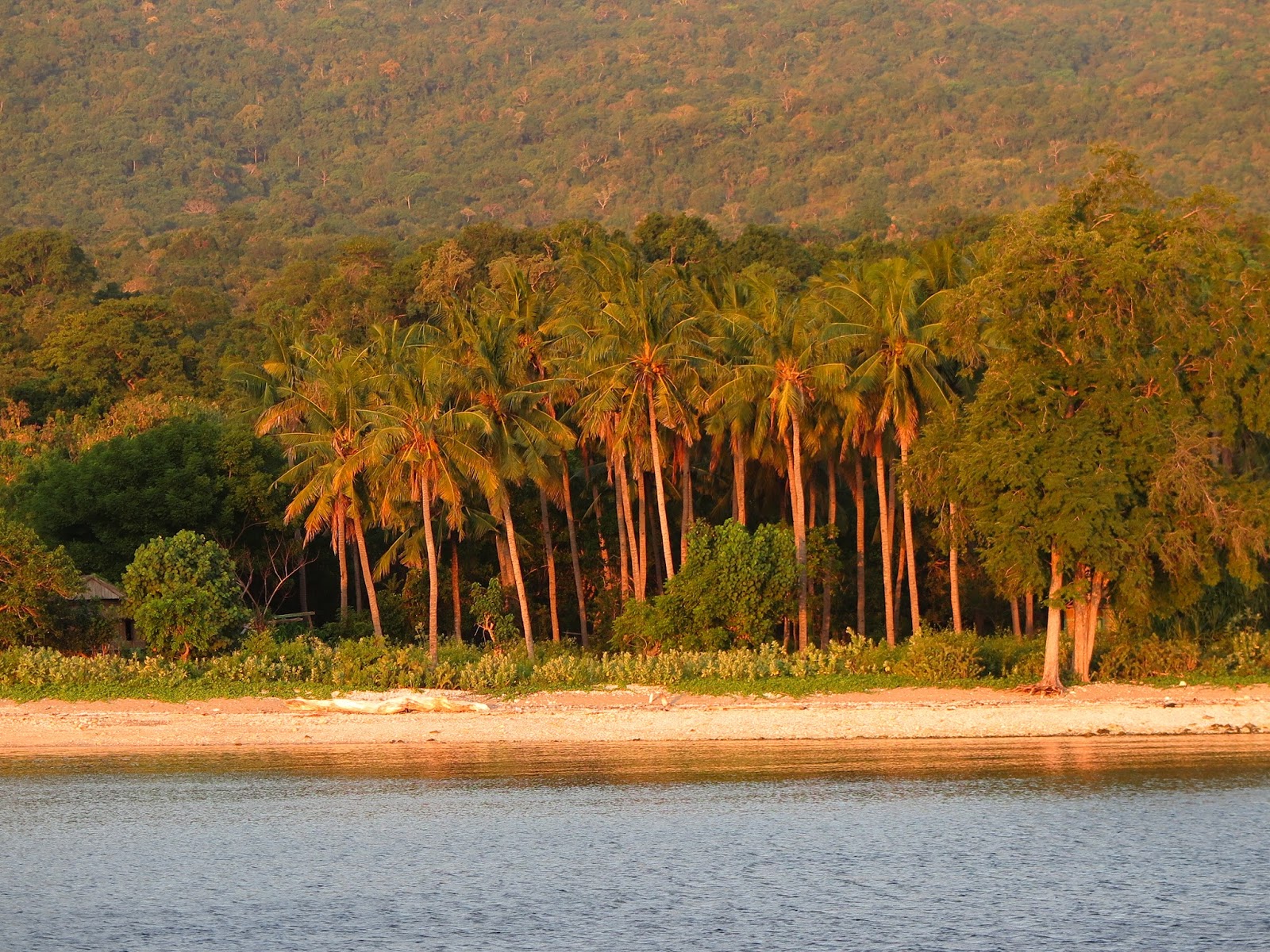

Coconut Palms in the evening light on Moyo Island
We arrived at Moyo Island the next day and liked it so much, that we stayed for 3 nights.

The southern have of Moyo island is a national park area, without a real village, just a few local fishing huts.

The northern half of the island has a very exclusive resort, the Amanwana.  It consists of 20 amazing tents and a very large public area for the restaurant.  We took our zodiac over, anticipating a nice lunch ashore, but the asking price of 100 USD each,( for lunch!) made us change our minds.  The staff gave us a tour and explained most of their guests came for the diving, and bragged that British Royalty were fond of the spot.  I looked up their website later to see that a 3 day visit is in excess of 4000 USD.  Seems hard to believe a place like that could exist in such a remote location.  It was lovely though!


Local fisherman, hand-lining from a dug out canoe
Our boat was anchored about one mile away around the corner from the resort, offshore of a nice grove of coconut trees.  Before long children of the local fishermen came out to barter drinking coconuts for whatever they could negotiate for in trade.  We were also happy to trade for some local Bonito (small tuna like fish) that were jumping everywhere in the bay.  Yummy.  Our offshore trolling for fish was not going well, and these were the first fresh fish for us this trip.


Bonito for dinner.. from the local fisherman!
In the evening, the water here glowed with thousands of star like bluish spots of fluorescence.  I have never seen anything like it before. Looking down in to the water next to the boat, there were an amazing variety of flashes of light.  Long bold deep streaks of some larger animals and smaller near surface ‘blebs’ of light.  Very surreal indeed on this moonless night it was almost impossible to tell the stars in the sky from the animals in the sea.

Moyo Island is a magical place, we loved it there.  It was also nice to be in a park, away from a village area.   We enjoyed the privacy and spent 3 days reading and snorkeling and enjoying the incredible natural surroundings.  The island is known for its monkeys and ‘barking’ deer.  While we did not see either, we surely heard plenty of jungle noises every night…together with the fluorescence ocean life everywhere in the sea, it all added up to a very strange and exotic place, especially after dark.

Kananga Village


Nice sailing! 
 View of Tambora volvano on Sumbawa.
Tambora erupted in 1815 and brought a
global 'year without summer' due to
the large volume of ash released.
 
Katmai underway in 10 knots of breeze...Nice!

We anchored off of the small village of Kanangas for one night.  It is known as a stopping off place to go to visit the nearby island (2 miles) of Satonde, which is a volcanic crater that hosts a green saltwater lake.  Unfortunately, the day we came through, the wind was blowing at 20 plus knots too windy for a dingy ride across the open channel and too rough to try and anchor Katmai next to the crater island. 
The wind made for a great sail though, and we saw numerous pods of pilot whales and dolphins.
So we gave the lake a pass.  We traded with some locals for bananas and papaya and gave away more hats, shorts and shirts to young boys who paddled up in their dug out canoes full of smiles and laughter.  We only stayed the night and left about 6 am, when the sun was just above the horizon. The sail to Kilo was going to be a long day, so we needed to start early.


That evening at sunset, we were surprised by 100s of ‘flying foxes’, fruit bats, that flew over us, from mangroves on Satonde and over to the main island of Sumbawa.  They are huge, and at first glance look like large slow moving owls in flight, but sure enough they are bats and with a wing span of up to nearly 4 feet, I was glad to sleep below deck that night!  Spooky!


Kilo
The village of Kilo sits in a very small bay within a larger bay on the north side of Sumbawa Island. On the way there we passed yet more large volcanos that clearly formed the island, not that long ago. 

We gave out dozens of paper school pads and pencils to the seemingly endless stream of dug out canoes with children.  They were very happy with the little gifts, shouting and yelling to their friends onshore, waving their little treasures, even doing happy dances on the way back to shore.  Again, we stayed only for the night, having arrived in late afternoon after a nice sail to the anchorage.  We were pleased to find the local winds in the bay from the north, which allowed us to head directly to the anchorage and not have to tack up wind in the normally predominately east to southeast trade wind.  We expect some sort of local sea breeze was blowing, influenced by the huge topographic relief on the volcanos.


A Fish Attracting Device (FAD).  Very common features
 (to avoid) in the local waters.

On the way in to the anchorage, the area was full of FADs, Fish Attracting Devices.  These are unlit, floating collections of drums, bamboo and other miscellaneous bits.  The locals use them to attract fish, and often fish near by.  They are, difficult to see, and impossible to see at night. No night time sailing in our future. They must be effective, because we have seen literally hundreds of these, often miles from shore.

Wera Bay

Village of Wera, located on the northeastern shore of the
Island of Sumbawa.

The last anchorage on our journey east across the island of Sumbawa, Wera Bay is known for its boat building.  Apparently the specialty of the village is the manufacture of rather large wooden ships and several thatched sheds on shore loosely concealed the hulls of at least six huge boats, and many smaller vessels.  The boats are built in the traditional way, with only wooden pegs for fastening, no metal.  


We witnessed the maiden voyage of this large 'Phinisi',
clearly still under construction.  Note the people on deck for scale. 
She is a HUGE boat.
We were fortunate to see a partially completed boat that clearly was on its maiden voyage come back to the village just before sunset to anchor near us.  Many boat loads of locals and apparent officials were offloaded by skiff and whisked back to shore at dusk.  The boats build here are reportedly up to 30 meters in length.


The active volcano Sangeang forms an island
off the village of Wera.  She has been venting since the last
eruption, which was in May 2014 (those are NOT clouds!)
We considered staying around and visiting the shore to view the boat building the next day, but reports from other cruisers about theft from their decks in this anchorage and the very ‘cheeky’ nature of the village children that rowed out to ask for gifts left us feeling the best thing to do was to keep moving and so the next morning very early we set sail away from Sumbawa for Komodo, which really was our destination after all.


11 June 2015

Lembongan to Gili Aer


Angela trimming the #2 Genoa
on the way to Gili Aer
We were delighted to have our friends from Perth, David and Angela, along with us from Bali to Gili Aer.  It was wonderful to see them and have their company after the long sailing from Australia to Bali.  It was great as well to have some additional hands for sailing and all the other chores of living aboard. 

It was good to cast the lines once again, and leave behind the hustle and bustle of Bali and its extreme tourism. Following a short three hour trip we arrived at the small island of Lembongan just east of Benoa, Bali. Lembongan is also all tourism during the day time. High speed motor cats bring loads of tourists from Bali to Lembongan for a day of snorkeling, partying and yes even riding a fake submarine, that never makes it below the water’s surface – yes, tourism at its best!


Traditional fishing boat, Gili Gere...a 'spider boat' !
The next day, we set course for Gilli Gede at the south western tip of Lombok Island. Finally away from tourists! Gilli Gede is a sleepy small island with a couple of fishing villages. Very quiet and picturesque and a major cultural change. Lombok is primarily Muslim and with that you hear the call to prayer from the local mosques.

We spent four nights at various places near Gilli Gede. Had some good relaxing times with Dave and Angie, plenty of swimming, reading and sharing great meals and good wines. A lovely relaxing time.


The 'marina' at the southern tip of Gili Gere
From Gilli Gede we set course for the north western corner of Lombok and the island of Gilli Aer. This is another favorite island for young western tourists, mostly young backpackers. The island has some great diving and surfing to offer along with reasonable priced hostels and bungalow type hotels. The small town had a grocery store for some needed food supplies and lots of waterfront restaurants, which we enjoyed to the utmost.
 

David and Angela at the coffee shop on Gili Aer
Following our second night at Gilli Aer, Dave and Angie departed Katmai for Bali by local ferry transport and then back home to Australia. Our time with them was a wonderful treat.
For us it is time to sail east over the top of Lombok, then Sumbawa and finally the Komodo islands.


04 June 2015

Bali, 30 May to 3 June


The evening of our arrival day, the Fremantle to Bali Rally together with the Indonesian Ministry of Tourism, organized an incredible evening of traditional dance, music, food and speeches, for all the rally participants. The event was held at one of Bali's grand hotels on the beach. As tired as Laurie and I were, we had a fabulous evening along with the two-hundred and some other rally participants, including family and friends who flew from Australia to Bali for this reception. All yacht owners and crew were called up to the stage for a special recognition. Laurie and I made that trip to the stage twice, the second time in recognition of being the only short-handed rally yacht, meaning only two of us on board.  It was very nice of our Australia friends to do that. 


Approach to Benoa Harbor, Bali. 
Navigation here is challenging

Indonesia is a cruising paradise, but the paperwork remains politely said 'difficult'.   There were problems with our cruising permit that required time to sort out before we could depart Benoa Harbor in Bali. We finally did get our entry papers after three days of non-stop pressing our 'agent' .  In the end he came through. Yes, 'agent' - most yachts hire an agent to deal with the Indonesian clearing in and clearing out procedures.
The next day our Perth friends Dave and Ange arrived in Bali by plane. We planned to spend the next ten days sailing east to Sumbawa in their company. The best laid plans sometimes need a big dose of flexibility. Since our clearance papers were not ready, we instead hired a driver to show us the country side of Bali and we spent three lovely nights in a hotel, with 'endless showers' and cool rooms. Ahhh, how you learn to appreciate a long cool shower in the tropical heat when you live on a boat where fresh water is a very precious resource.
 
This is my first time in Bali and Laurie's second time. Bali seems very crowded. Even in the countryside you feel crowded, though it is beautiful, volcanoes, terraced rice paddies on steep slopes and interesting villages and Hindu temples. It is also, it appears, where to world merchants come to buy all the Indonesian crafts we see in stores like 'Pier One', etc. Each village, and there is no noticeable demarcation between them, has a specialty craft. It maybe wood carvings, or yard statues carved from stone, or baskets, or gold and silver items, or batik...etc. In a yard statue village for instance, you will find small shop after small shop, an endless number of them, selling nothing but stone statues for yards. Apparently all these Balinese villages attract artisans from all over Indonesia to make and sell their craft items to world merchants and some tourists.

Terraced rice fields in northern Bali

 The terraced rice fields of Tegalalang are world famous.  Lovely views were enjoyed from a café on the rim of the valley.
 
Near the village of Ubud, Bali there is a monkey forest that has many cheeky little long-tailed macaques.  Our driver wisely advised us not to feed the monkeys as they can get aggressive.  We saw several tourists dealing with the aggressive ones as they tried to grab bags and even sunglasses.  Of course, there are stands that sell bananas as well as a first aid station.  Go figure.  It was beautiful, green and lush in the forest.

Cheeky long-tailed macaques of the Ubud Monkey forest
Well on our third day in Bali we finally received our Indonesian clearance papers. They even included Laurie as crew on Katmai! Oh yes, all the other people originally erroneously listed on our permit as crew are still there. In the meantime we figured out that these additional people on our permit are the crew of the sailboat a different yacht in the rally. Apparently a cut and paste error by the agent when he submitted our cruising permit request to the Indonesian government last April.
Now with full tanks of diesel, water, and our food stocks resupplied, Dave and Angie on board we set off to the east for the nearby island of Lembongan on 3 June.

More to follow, Laurie and Eric


01 June 2015

13 Days at Sea - Femantle to Bali - 1450 miles

The down blasts of wind were pulverizing the ocean water, flying spray made the ocean look white and very wild.  The gusts were hitting 60 knots.  It was all very cool looking from the Fremantle Sailing Clubs second floor bar. The rally start was postponed for two days to let a very impressive storm pass.

It's been a whirlwind since we departed our slip in the Fremantle Sailing Club yacht basin on May 19th. Even as we started two days later than planned due to the storm, the seas remained washing machine like from after effects of the storm. Once we started sailing, Eric was more than a bit green due to the nasty motion. The first three days of the sail north along Western Australia's coast were very tiring and taxing on us both. Sleep was disturbed due to the seemingly random motion of the large left over swells from the storm, plus Eric was seasick and so not much help below decks. Fortunately Laurie managed the motion better than Eric did, it also meant that she spent more than her share navigating, cooking and keeping Katmai ship-shape.  It was feast and famine, after initially having too much wind, the next week we were plagued by too little wind.

The best part of the midnight to 6 am watch
 shift is the sunrise !
We had one full 24 hour period of zero to one knot of wind and most other days the wind was less than 5 knots. We did a lot of motoring and drifting! The calms were interrupted by squalls at times, one of which hit us at night, no moon, pitch black and massive amounts of rain. We tried our best to find the shortest way out of the squall, but as hard as we tried in just about all directions of the compass the squall seemed determined to stay on top of us. It was a bit on the scary side things. Once the squall finally moved on it presented the most spectacular lighting show I have ever seen. Well, after that bit of excitement the wind dropped again to near nothing.


Finally, the trade winds returned to normal
and we made great time the last 3 days. A nice 8-15 knot easterly!
We coaxed Katmai north it seemed inch by inch. We only started to get the first sign of real wind north of 14 degrees south latitude, mind you we started at 28 degrees south latitude, when the trade winds slowly filled the void. Our last two days at sea were great sailing, reaching in 15 to 25 knot trade winds. Bali here we come! The only problem was that the approach to Bali and the Lombok Strait is a major international shipping route. A seemingly endless parade of tankers and other large merchant ships kept us awake as we had to judge each one to insure we did not get too close to these fast moving monsters.


Approaching the finish line with "Plus 16".
13 days and 1450 miles and we arrived at the same time.!
Arriving in Bali was great, after nearly 14 days at sea we converged with another rally boat, called 'Plus 16', just a few miles from the finish line. What are the odds of finishing neck to neck with another rally boat after nearly 1500 miles at sea? On reaching the Benoa Harbor Marina we were greeted by a fantastic reception. There must have been 50 some rally members on the dock waiting for us with cold beers and cheers. It was really touching after so long at sea to be greeted so warmly by our friends from Australia. We arrived exhausted, but healthy.

There were a couple of highlights from the 13 day trip from Fremantle to Bali:

Frustrations during the calms.

During our calm days near the northwest coast of Australia, off of Carnarvon, we were able to raise a small sail that Eric had in his bag of tricks called a dazy staysail.  Having the main sail up in nearly no wind was really difficult as it slatted and banged around, not good for the sail or our nerves.   The Dazy Staysail flies free like an asymmetrical spinnaker, but it is much, much smaller.  We flew it on the foredeck (without any other sails), and were able to make 10 miles in 5 hours, in nearly no wind....but eventually, even the tiny little zephyr winds died and died dead, so it was back to motoring slowly north.  We even started to chase after thunderheads and clouds:  We had been watching several thunderhead heads form along a line about 14 miles away, heading toward us, sort of.  We decided to see if they had wind, and motored next to them and set a double reefed main and our staysail…ready for a gale.  Boy, did they have wind....15 Knots max. (Sarcasm intended).  A bit of rain felt good, it was darn hot.  After the clouds passed behind us, we broke out in to a new weather domain, and we got all excited.  There was a stable, but low ESE wind, at 2-4 knots.  Party time!  We hardened up and sailed close hulled, and the apparent wind allowed us to ghost along with actual sails up.  We sailed alike that for a few miles but by at 4 pm that day, even that wind died, really dead, and the sea, hundreds of miles from no where was like glass and almost oily looking.

Visitors in the Night:

On May 27th, we ghosted along under sail in total darkness in 2-4 knots of breeze in order to conserve our last tank of diesel.  We were in the middle of the Timor Sea, waiting for the trade winds to blow from the east as predicted on our weather forecasts.  Literally from about 10 pm until daybreak a pod of about 15-20 smallish dolphins played in our (tiny) wake.  They jumped around and got really animated when we hit any boat speed above 3 knots.  It was like they were encouraging us to go faster!...We only initially knew the dolphins were there in the dark because Eric could hear their breath.  I truly first thought that Eric needed some sleep and was delusional...but he was right, a flashlight confirmed we were in large pod of dolphins.

During the day, we had seen the dolphins chasing schools of flying fish that would leap out of the water and coast 100’s of meters in the air when the dolphins where pursuing them.  Katmai too chases up flying fish, it is very common to see schools or individuals sailing way in the air from our bow at 45 degrees.  We almost every morning find a few on the deck, dead.  They are 8-12 inches long.

It did not occur to me until later that the dolphin were after flying fish that Katmai distracted, but it is possible.

To top that off, after my morning nap, as I was waking, I put my hand on the floor board next to the bed and at the same instant that I felt a damp scaly thing, the fishy smell of last night's flying fish casualty hit my nose. Made me let out a little scream! Oh my, this poor devil actually flew through the open window on to the floor by our bed!

31 May 2015

Arrived Bali

We arrived in Bali safe and sound on Saturday morning 30 May.  We'll write a longer entry and summary of our 12 day ocean voyage once we get reliable internet.  Cheers!  Laurie and Eric

18 May 2015

And we are off!

The start of the Fremantle to Bali Race/Rally 2015
Monday 18 May, 10 am Fremantle
The race/rally started this morning per as rescheduled.  It is a fine day for a race, 10-15 knots of sw breeze with a few light rain showers.  

We will not be able to update often as we will loose internet connectivity soon.  We will be sure to update once we get to Bali, which could be a couple weeks, depending on the winds.

You can follow us on the Yellow Brick Tracker link to the right! Cheers!


17 May 2015

Weather Delay Continues

Today's weather map.
We are in Fremantle, snug in the harbor,
right under that Low Pressure system on the west coast.
 
We do not need the weather map to know that the low is directly south of us.  It is gusting up to 45 knots here in the harbor and raining buckets.  
The Race/Rally has been officially delayed another day, until 10am Monday.  
In any regard, we will wait for much calmer weather and fair forecast before departing!  So, for us all is good, the boat is ready and we even have some time to read and nap!  How good is that !


16 May 2015

Delayed by Weather

The Fremantle to Bali sailing rally/race has been officially delayed for at least 24 hours due to weather conditions in the Perth area.
The Low Pressure system to the southwest of Australia has
caused a delayed start.  Glad to be in the harbor for this.

We hope to get started Sunday or Monday, weather permitting.
Once we start, you can follow the race on Yellow Brick Tracking, which has tracking equipment on all yachts.  Look for us by our boat name, Katmai. http://yb.tl/f2b2015


As we sail north to Indonesia, we will be moving away from these southern hemisphere Autumn low pressure systems.

11 May 2015

Safety First

We passed our 120 point safety inspection last week, which basically aligns us with the Category 1 offshore racing regulations that are pretty much standard across the globe. It was a good and interesting exercise that definitely gets one thinking about safety, especially prior to a major offshore passage.  Our trip to Bali will be about 1500 nautical miles, so a fair distance.

Eric securing the base of the mast with
1/2" dyneema line with a  Kevlar cover.
You could lift the whole 51' boat with that!
We improved a few things on Katmai, and upgraded some personal safety gear. On Katmai, we tied down the mast where it steps on to the keel of the boat.  The thinking here is that if there is catastrophic mast failure, having the base secured will prevent the base of the mast from coming loose in the boat and causing more.  Really an unlikely event, but just in case, it does hurt to have it secured.

Locking mechanisms were added to the hatch boards, and safety orange sailcloth sewn on to our storm sails and large sail numbers to all sails.  Our sail number 43560 is now prominently displayed everywhere, including on big lee cloths on the side of the cockpit.  The purpose for both of these sail modifications is to make the boat more visible, primarily from the air.  It can be difficult to pick out a sailboat with white sails and white hull from the white caps of the waves and through the white of the clouds from an airplane.  In addition, we are traveling through a part of Australia that is heavily patrolled from airplanes by the Australian government. It is good they can identify us easily.  We also had an emergency rudder built that can be added to our Monitor wind steering system, if needed.

On the personal safety equipment side, we have made several enhancements. Our inflatable life jackets were about 15 years old, and while they are well made and still passed the 24 hour inflation test, technology certainly has come a long way.  We upgraded to new life jackets which have many new features, and added personal Automatic Identification System AIS beacons (Kannad R10 units) that deploy if the life jacket inflates.  A unique emergency alert is transmitted to all AIS receivers, which all commercial vessels and many pleasure yachts now have installed.  AIS is basically like air traffic control on the water.  Boats can send/receive unique signals that broadcast their name, position, speed and direction of travel and can be plotted on a real time map.  Basically AIS is a collision avoidance tool, but also can act as an tool for emergency notification to near by vessels.  To see more about AIS, check out https://www.marinetraffic.com/ and zoom in on your favorite part of the world’s oceans.

We have also added significantly to our medical kit on board.  It has been an interesting journey through various classes and lectures to learn how to the use the medications.  In Australia, sailing vessels participating in sponsored races are able to purchase a set list of medicines and medical supplies directly from a pharmacy.


Katmai is well prepared for the upcoming journey and well equipped from a safety standpoint. 

28 April 2015

Pre-trip Haul Out: 10 days ‘On the Hard’


Katmai being lifted out
One of the big chores prior to departing on the Fremantle to Bali Rally requires spending some time ‘on the hard’.  Being on the hard refers to the time the boat spends out of the water in stands in a boat yard. This makes it possible to work on the parts of the boat below waterline.  

Chores include cleaning the bottom of marine growth, sanding, repainting with ‘antifouling’, buffing and waxing the ‘topsides’ and servicing the propeller and shaft.  These are big chores, generally done by cruisers themselves and but when we were working we had the luxury of hiring someone to do the heavy work. Now that we are retired, we do it all.  However, we did hire out one bit this time, the application of 'propspeed' to the propeller and shaft after we cleaned them.  Propspeed really seems to prevent growth of marine life on the metal surfaces, so worth a rather expensive application by a specialist.


The view from 'on the hard' was awesome
Now we find it a pleasure to do work on Katmai ourselves.  It is after all, a lifestyle. One lesson we learned is to work on the boat in the yard during the spring or autumn in Fremantle.  We have been out of the water before during the height of summer when temperatures exceeded 100F every day, and with the sun and hot asphalt, well we simply roasted….add the pleasure (not) of a steep climb down 15 steps from the boat to the pavement and hike to a remote restroom at night and back up those steps, and well, I was not a happy camper.

This time, weather was perfect, days much cooler, in the 70’s (F).
As I write this, we are just back ‘in the water’ always a big relief after the stress of ‘haul out’ and 'put in'.
Eric painting the rudder
We are also trying a new bottom paint, Juton, which is highly recommended by many sailors here in the harbor, and roughly half the cost of the Micron 66 we used the last few times. Yeah! Bottom paint we use is self ablating, meaning it slowly wears away as you move through the water, to discourage the marine life such as barnacles, corals etc that desperately try to make your hull their new home.  

The new Juton paint application went really well. In the photo, you can see Eric here doing some touch up on the rudder….also gives you an appreciation for the scale of things…he is on a ladder to reach the top of the rudder.  Katmai has a 3 meter draft, so lots of ups and downs on ladders and scaffolding, and then there is the work of having an electric buffer above your head polishing all 50 feet of each side of the boat.  It looks amazing!  We will never complain about waxing our car again, ever.

Katmai in her stand and our car 
loaded with spare parts for sale
We also had a bit of a 'yard sale' in the work yard.  We had a storage shed here with spare parts and surplus from our refit of Katmai. We are determined to lighten that load, clean out the storage unit and close it down before we leave. Two weeks ago, our club sponsored a 'treasures of the bilge' event, basically a group garage sale for sailors.  Between that event, some well placed adds on www.gumtree.com.au and our 'yard sale in the yard', we have made our goal of being shed-less (I know, a frightening state of being for some!).


More later, Laurie

20 April 2015

Three Weeks in a Cubic Meter

Eric working in the stern locker.
As an example of what we have been doing here on Katmai these last months, we would like to share some details from one of our larger projects which took place in one of the tighter/smaller physical spaces on Katmai. (This is probably why this work was last on the list!)


The stern area on Katmai contains fair bit of complex equipment:  The NKE autopilot hydraulic ram, the quadrant at the top of the rudder, the Webasto heater and related glycol tanks, the SGC antenna tuner and related equipment, as well as a lot of ’boat plumbing’(various hoses and wiring).  The space is also very small, therefore needs to be well organized and of course very sturdy for items like the hydraulic ram which mechanically turns the rudder and is under a great deal of lateral force.  The space is so small to work in that Eric, and I to a lesser degree, have become contortionists. 

There basically is room only to sit, or kneel in a contorted way, and of course reach here and there, grind, fiberglass, turn wrenches, screw drivers and cut.  Working in such a small space is very tiring to say the least, and brutal when it is hot and sunny.

top of the rudder post with attached quadrant,
rudder angle sensor and business end
of the NKE ram that drives the rudder. 
Eric basically removed the heater, auto pilot ram and all related equipment and rebuilt from scratch their supporting structures.  This entailed building new marine plywood for-aft bulkheads and using fiberglass to secure the bulkheads onto the boat structure for strength.  A new platform for the autopilot ram was then constructed, the ram bases (we have a spare ram) mounted with substantial backing plates etc.


Heater the starboard side of the locker. 
White cylinder is an 'ugly balun' that Laurie
made for the HF antenna feedline.
The Webasto heater had been out of service for the last couple years as we needed to move the glycol storage tanks when we installed the generator.  The heater was also due for a major maintenance/rebuilt  as well.  

Largely, this was an Eric job, although I spent a several long days in the locker myself doing the related wiring jobs that the heater and autopilot ram required as well as many hours working on our High Frequency (HF) radio installation.  We’ll write another entry about radios one day, but it certainly has been fun as I learned a great deal about marine single side band (SSB) and HF radio installations.  Fun in a very technical, geeky sort of way!  All working great now!

Fortunately, we are done in the stern locker, the seat cover has been re-installed and we are on to other details of our preparation to leave for Indonesia in mid May.  -Laurie

19 April 2015

Welcome to Laurie and Eric's Blog !

Hi Everyone!  Welcome to Laurie and Eric’s new blog.  We are currently in the final stages of preparation for the Fremantle to Bali sailing Race/Rally, departing Fremantle, Australia on 16 May 2015.  The trip is approximately 1500 nautical miles, and should take us about 10 days, depending on weather/wind conditions. With a total of 20+ sailboats participating, it should be an interesting adventure.   We plan on spending several months Indonesia, focusing our sailing area east of Bali.  We’ll then sail back to Australia in August 2015.
Likely route to Bali from Fremantle

Our motivation to join the Rally was multi-fold:

1. We recently retired from busy, full-on careers so this was a great way to transition to sailing part of each year, which has been a dream for a long time.

2.  The structure of the rally brings with it great opportunities for safety training, such as courses in safety at sea, first-aid, medicine for sailors, as well as a rigorous set of standards that the boat must pass.  (see reference).

3.  We really enjoy the Fremantle Sailing Club, where we have been members for nearly a decade.  It is a fantastic organization, with world class facilities, activities and wonderful set of friends.  We are proud to be participating in one of their major events.

4. We have always wanted to see more of Indonesia.  Eric’s father was born in Indonesia to a Dutch colonial family near the turn of the century, so for Eric, it will be wonderful to see the places his father knew as a child and wrote about as a young man.

Our sailboat Katmai has been here in Fremantle since early 2008.  You can read about Katmai and the trip Dick and Peggy made to bring her to Australia from Alaska.
We have been here in Australia for the last few months, preparing Katmai for long distance sailing and spending time on the ocean with great friends who traveled down from Alaska. We also had a great couple weeks sailing locally with a cousin from the USA.  It also has been a time to reconnect with many wonderful friends we made during our years living in the Perth area and to make new friends.

So now, we are in the final stages of preparation:  Anyone want to help shop and pack on the boat food for 4 months ?  And of course there always is the final ‘haul out’ of the water to do the annual maintenance on the bottom of the boat.

More to follow, Laurie